Wednesday, 20 January 2010

Evaluation- How did you use media technologies in the construction and research, planning and evaluation stages?

Use of technology during research:
  • I used the internet to research documentaries surrounding the genre. I used YouTube to research specific Dubstep documentaries, also made by students. I was able to observe the issues and themes they explored and focused on; particularly which questions they were asking and the sequencing.
Use of technology during construction:
  • I used a Sony Handicam to shoot my film; the size of the camera meant that it was easily transportable, making it easier for me to travel and shoot in busy clubs. Whilst filming indoors or in poor lighting, I could manipulate the settings to achieve the best quality film possible. However, given the pixel quality of the camera, my documentary doesn't appear to be of professional quality, more of a home video; this issue comes from the production value and considering I have no funding it is inevitable and can't be helped.

  • Alongside the Handicam, I also used a tripod; This was essential during interviews. The set up had to be precise, as it is a common convention of documentary interview to have a side on shot of the interviewee. Moreover the eye line had to be precise as well as avoiding the movement of a hand-held camera which distracts the audience from the interviewee.
  • Whilst filming in clubs, I used a fish eye lens to enhance and create the urban feel of my documentary. The fish eye lens gives the illusion of there being more people in a club as well as allowing me to bring the camera as close a possible to my subject whilst capturing the context. For example, I recorded a DJ through a fish eye lens- whilst I waned the focus to be on him, I also wanted to include the club atmosphere, in order to put the DJ into context.
  • For my print-based production; newspaper advert and magazine article, I used a digital SLR camera. I needed to use a high quality camera so that I could easily edit it on the computer without it becoming pixelated. I was also able to manipulate the shutter speed, creating 'trippy', colorful pictures which created a sense of excitement as well as accurately portraying the clubbing culture.

Use of technology during Editing:
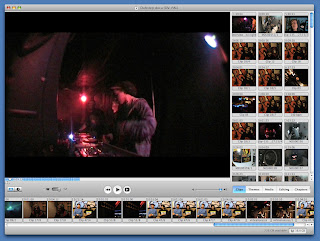
  • To edit my footage I used iMovie HD. Although it was fairly simple and straightforward to cut and sequence my footage, iMovie is a simple and basic software. Due to the nature of my documentary, I found it extremely annoying that there were only two audio layers available. Final cut Pro is a professional software, much more advanced; it would have been easier to manipulate and layer sound on this software. The fact that my documentary was is focused on realism, I avoid 'fancy' transitions, meaning that I stuck to simple cuts, in this sense iMovie HD was more or less adequate for my production.

  • To edit the ancillary projects I used Adobe photoshop CS3. Having never used photoshop before, it was extremely complicated for me to get my head around it. However, I was able to produce professional looking ancillary texts as this software is widely used in the production of commercial magazines and posters. In the example screen shot, I demonstrate the way in which you can adjust the picture in numerous ways.
Use of technologies during evaluation:
  • I used social networking site, facebook to get audience feedback from my target audience. There is a very very big dubstep, file sharing community online, for example: http://www.dubstepforum.com/. Therefore, understandably there is a large presence of people who like Dubstep on facebook. Additionally, I was able to show my documentary to people who didn't listen or know about the genre. Moreover, it wasn't time consuming and extremely straight forward as well as ecological!
  • I uploaded my video on to Youtube, in order to be able to share it on facebook. In order to do this, I had to convert my video so it could be played in quick time.
  • The concept of post-modernism can be applied here as YouTube turns the "audience" into "producers" merging the two, the audience become active.

Evaluation- What have you learned from your audience feedback?s

I targeted a group of AS Media students to conduct the first part of my research. I showed them the clip and on their copy of the questionnaire was a picture of my newspaper ad. The results are as followed;

  • Would you watch the full version of this documentary?

100% replied yes

  • What are your reasons? Responses included;
"Interesting and engaging"

"It seems interesting and lets you know how their [the artists] career started."

"Informative and interesting"

"I would like to know more about underground/underrated artists in comparison to mainstream artists"

"I like Dubstep"

  • Is the documentary engaging?

100% of the people asked said yes.

"It uses different points of views"

  • How effective is the newspaper in advertising the documentary?

"Yes, the fact that it's channel 4, (usually intriguing documentaries), good design"

This proves that my choice of instituiton was significant and effective. By using the instituitons reputation I can immediately reflect the vaules of my production, attracting the appropriate audience, as well as appealing to a segment of their existing audience.

"I'm not sure what message it's trying to get across"

"Not clear what it's about"

This is expected, my newspaper ad is targeted at channel 4's existing audience as well as my niche audience who are particualarly interested and involved in the Dub and Dubstep genre. People with an interest in electronic music such as Drum'n'Bass and Jungle would also find this advert appealing, as proved by my research into this segment of my audience.

100% of people asked from the second part of my research thought that the advert was effective. Responses included;

"It seems like its an independent production, indicating that it'll be more informative and personal, in line with the underground nature of the genre."

  • Would this newspaper ad make you watch the documentary?

98% of people asked answered yes

  • Has the documentary taught you about the Dubstep genre? Is it successful in being informative as well as visually entertaining?

100% of the people asked said yes.

Evaluation- How effective is the combination of your main product and ancillary texts?

I have taken screen shots from my documentary to compare how my ancillary texts feature the key themes explored in the documentary.


The newspaper article, focuses on Dubstep being an electronic genre. Both texts create a sense of the club and rave culture surrounding the musical genre. In my documentary, this is done through symbolic imagery, for example strobe lights and turn tables. Similarly, my newspaper article features a picture of a DJ mixing at turn tables: this is also symbolic of the rave culture. In addition, a lot of the footage is recorded inside a club, resulting in poor lighting; I managed to also create this feeling in my newspaper article by using a black background.


The exploration of the historical influences of the genre are focused on through this imagery. Red, Green and Yellow are recognised as Rastafarian colors; I was very sure that these three colors would dominate my newspaper advert. My target audience automatically create an association between themselves and my product as they identify themselves with the Rasta culture. The newspaper advert works well with my ancillary product as it features one of the most predominant influences on the Dubstep culture.

Evaluation- In what ways does your media product use, develop or challenge forms and conventions of real media products?


"A step from Dub" extract (final)

Monday, 4 January 2010

Possible Double Page Spread Pictures


Final Brief

Brief- TV Documentary
Main Product- 5 minute extract from a one hour programme
Ancillary Product 1- Double page spread from listings magazine
Ancillary Product 2- Newspaper advert for documentary
Target Audience
Demographics: Aged 18-29
Psychographics: Will be interested in electronic music, Garage, Jungle, Drum'n'Bass and Reggae genres and would be involved in the underground music scene.
Lifestyle: Social, young, diverse, talented, music will be a big part of the audiences life.
Similar Media Products- The Dubstep movement- Hug the Sub, BBC Collective Sound of Dubstep, The Family
Justification for choice of brief- I have knowledge of constructing documentaries and an understanding of the form. So, I thought, given the conditions it would be the most appropriate brief. Dubstep is amoungst one of my favourite genres of music, my weekend social events are usualy centered around a Dubstep rave. I am familiar with many DJ's and producers in the genre.
Narrative- I will use a non-narrative construction as I feel this is the most appropriate narrative for my documentary. I will not be conveying a story, just informing people of Dubstep. I will be using the 'Fly on the wall' format in a similar way to how The Family used it to document their footage.
Creativity- My documentary will involve footage from inside a rave and will include interviews of artists.
Challenges Anticipated- Organising filming off school grounds, sound issues inside the club, lighting issues
Digital Technology- iMovie, Sony HDV Handycam, Cannon Camera

Wednesday, 25 November 2009

Institutional Research


Channel 4 have said the following in their unique institutional model;
  1. "Channel 4's output reflects the enduring values- of quality, innovation, diversity and distinctiveness - embodied in its remit."

  2. "Channel 4 does more than any other broadcaster to support independent production across the nations and regions."
Channel 4 readily express their support for independent production and "maintains a strong diversity of genres" (from Channel 4's unique institutional model). Their institutional values support my criteria, as my documentary won't be on a mainstream topic. As a result, I feel that they are the most appropriate Institution to broadcast my documentary.

Product research- Radio Times, First Magazine, and Time Out

First Magazine
Time Out


The large photograph and bold phrase "From Dusk Till Dawn" are visually attractive and engaging. Through the title, the reader is told about a central theme of the article; furthermore it is a familiar term that a wider audience can identify with. The text in the top right corner is written in white, a subversion of black font which captivates the readers attention. I believe this is an appropriate approach in order to target a younger audience, a large bulk of black text could deter them from considering the article.


Radio Times

Product Research- Newspaper ad

The size of this newspaper ad is 24x16, this is a conventional and effective size for a newspaper ad. Both ads feature minimal writing and dominating, engaging pictures. 


Product Research


"Dubbed Out In Bristol" is a 16 minute documentary made about the Dubstep scene in Bristol. Although this documentary wasn't broadcasted or widely distributed, I chose to analyse it as it was dealing with the same themes and issues as my production as well as targeting the same audience.


"Dubstep - A Beginner's Guide" is a short documentary made in 2008 featuring top artists within the genre. This documentary was similar to "Dubbed Out In Bristol" in the way that it wasn't widely distributed.

The Family is a eight-part observational series, documenting the lives on families across the UK. The programme uses the fly on the wall format which I am looking to adapt on in my own work, combining interviews and fly on the wall footage in a similar way the programme does.

http://www.youtube.com/watch?v=Xf1RgNEeZkc: Interview clip
http://www.youtube.com/watch?v=g0WifjL9zoM: Voice over and Fly on The Wall footage

Audience Research


I can conclude from these results that a large amount of my audience will watch the documentary online if it is broadcasted. However, 1/2 of my target audience watch T.V therefore my scheduling remains important.


The results show that the majority of my target audience watch documentaries on channel 4 or online on 4oD. This has given me a direction as to what to research in terms of institution; it has helped me in reaching the decision to broadcast my documentary on this channel. Channel 4 have previously broadcasted programmes such as 'skins' and 'the inbetweeners'; they have also previously produced and broadcasted documentaries dealing with issues surrounding young urban culture. By doing this, they have created a target audience amoung young people; this is the same target audience I am looking to atttract.

My results show that the two most popular preferred documentary formats are investigative, for example Dispatches and Panorama and fly on the wall, for example the family. These results have lead me to look at Dispatches and the family to observe how they use these formats. I may try and incoorporate both formats, using aspects from each one.

These results confirm my belief that people are only aware of commericalised artists; this result reflects 13 of the people asked. The rest were all different but the names included; Mala, Loefah, Kromestar, Benga and Plastician.

These results give me information about my target audience. By knowing what other genres of music they listen to, I can reflect aspects of it within my documentary through sartorial codes and mise-en-scene, attracting a wider target audience.

Initial Brief

Brief- TV Documentary
Main Product- 5 minute extract
Ancillary Product 1- Double page spread from listings magazine
Ancillary Product 2- Newspaper advert for documentary
Target Audience
Demographics: Aged 18-29
Psychographics: Will be interested in electronic music, garage and dub genres and would be involved in the underground music scene.
Lifestyle: Social, young, diverse, talented
Similar Media Products- The Dubstep movement- Hug the Sub
Justification for choice of brief- I have knowledge of constructing documentaries and an understanding of the form. So, I thought, given the conditions it would be the most appropriate brief. Dubstep is amoungst one of my favourite genres of music, my weekend social events are usualy centered around a Dubstep rave. I am familiar with many DJ's and producers in the genre, I also know the director of a successful.
Narrative- I will use a non-narrative construction as I feel this is the most appropriate narrative for my documentary. I will not be conveying a story, just informing people of Dubstep.
Creativity- My documentary will involve footage from inside a rave and will include interviews of people on the street coming out.
Challenges Anticipated- Organising filming off school grounds, sound issues inside the club.
Digital Technology- iMovie, Sony HDV Handycam.